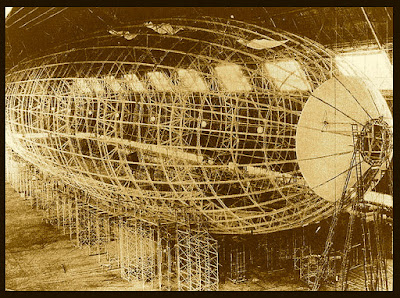
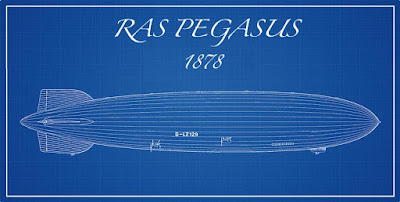
Royal Airship Pegasus was constructed in the Brunel Engineering Yards, Bristol, between 1877-1880. The frame is an especially alloyed aluminium, while the skin is of titanium. Pegasus is powered by steam, with heat supplied by an enormous crystal-electro dynamo supplied by the Telsa Laboratory. This dynamo instantly vaporizes water condensed from the atmosphere under extremely high pressure into steam which is then utilized to operate the various mechanical devices which propel the Airship and power its various facilities. Below - Pegasus under construction: Below - original working blueprint : Flammable hydrogen gas is not used for levitation of the Pegasus. Lift is instead achieved by using an enormous basalt crystal and ultra-sonic soundwaves. Basalt is both crystalline and magnetic. Gravity is really a frequency, part of Einstein's Unified Field. When crystallized blocks of basalt are resonated at the frequency of gravity (10x12 hertz - the frequency be...
This blog is based on an exhibition I held in Karangahape Road in Auckland in 2018, and is part of my "Lost World" series which, in turn, is part of my larger body of environmental art entitled: "Our Dying Planet" The Exhibition was entitled: "The 1888 Steampunk Airship Expedition to New Zealand in Search of the Moa - the legendary giant bird species of New Zealand" Below - original Pegasus airship blueprint: Artist Statement The purpose of this artwork is to help draw attention to the fact that New Zealand currently has the highest rate of species extinction in the world. The story suggested by this evolving artwork is that in 1888 a group of steampunk explorers fly in a metallic steam-powered airship ( RAS Pegasus ) to unexplored Fiordland (South Island, New Zealand) in search of the last of the Moa. Unfortunately, the extinction of the Moa had been rapid - it is estimated that within 100 years of Polynesians landing in New...


Comments
Post a Comment